

Free-to-free (bimolecular) recombination in semiconductors
Free-to-free (bimolecular) recombination is a fundamental recombination mechanism in semiconductors in which free electrons and holes recombine directly. The recombination rate is proportional to the product of carrier densities (\(R \propto np\)), and in organic semiconductors is often described by the Langevin recombination model, where the rate is limited by how quickly carriers encounter one another.
1. Free-to-free recombination (simple picture)
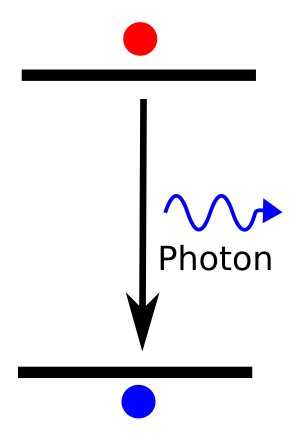
Free-to-free recombination describes the direct recombination of a free electron with a free hole, without the involvement of trap states, as shown schematically in ??. In its simplest form, an electron relaxes from the conduction band into an available hole in the valence band, releasing its excess energy. The net recombination rate is written as
\[R_{\mathrm{free}} = k_{r} \big(n_{f}p_{f} - n_{0}p_{0}\big)\]
Here, \(R_{\mathrm{free}}\) is the free-to-free recombination rate, \(k_{r}\) is the recombination rate constant, \(n_{f}\) and \(p_{f}\) are the free electron and free hole densities, and \(n_{0}\) and \(p_{0}\) are the corresponding equilibrium carrier densities. The term \(n_{f}p_{f}\) describes recombination, while \(n_{0}p_{0}\) subtracts the equilibrium contribution so that the net recombination rate is zero at thermal equilibrium.
This is called a second-order recombination process because the rate depends on the product of two carrier densities: one electron density and one hole density. If the electron density is doubled while the hole density is fixed, the recombination rate doubles. If both \(n_{f}\) and \(p_{f}\) are doubled, the rate increases by a factor of four.
2. Free-to-free recombination including k-space (momentum explanation)
In all recombination processes, both energy and momentum must be conserved. Photons carry energy but negligible crystal momentum, whereas phonons carry both energy and momentum. This distinction determines how recombination proceeds, as illustrated in ??.
In direct bandgap semiconductors (left-hand side of ??), the conduction-band minimum and valence-band maximum occur at the same k-vector, allowing recombination without a change in momentum. Energy and momentum can therefore be conserved through photon emission, leading to efficient radiative recombination.
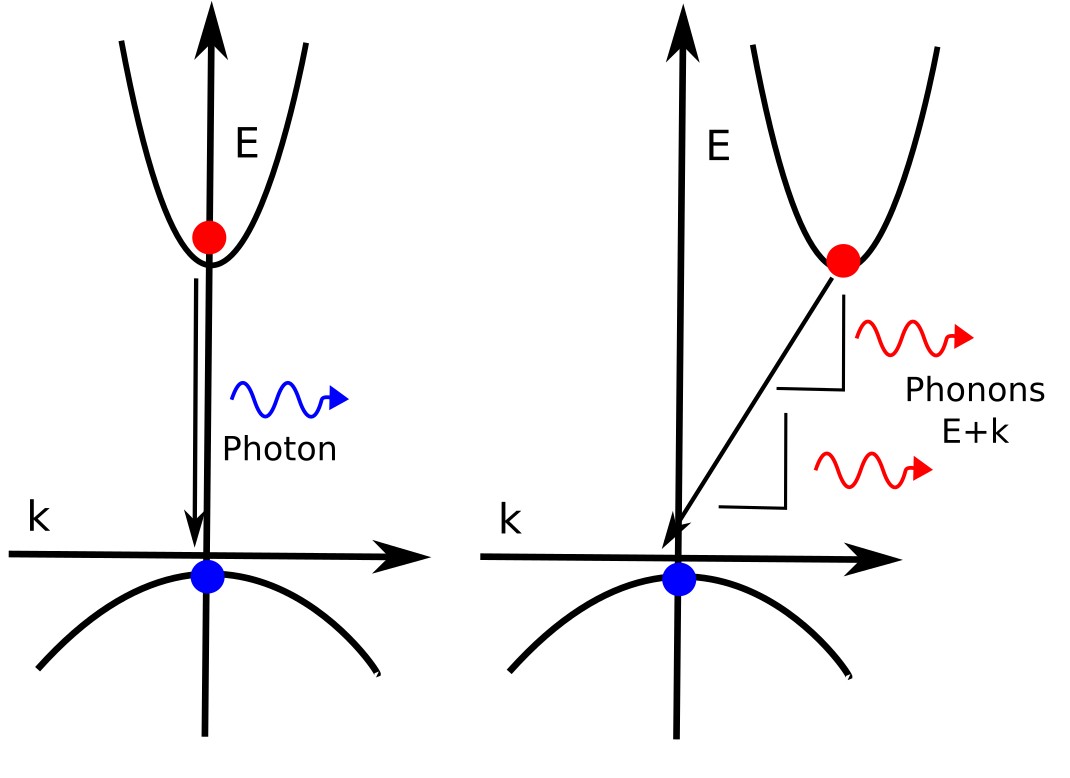
In indirect bandgap semiconductors (right-hand side), the band extrema occur at different k-values, so a phonon is required to provide the necessary momentum change. Recombination is therefore predominantly phonon-assisted and effectively non-radiative.
Free-to-free recombination is thus radiative in direct semiconductors and predominantly phonon-assisted (dark) in indirect semiconductors.
3. Langevin (bimolecular) recombination in organic semiconductors
In organic semiconductors, particularly in organic light-emitting devices and systems where carrier transport is not strongly trap-limited, free-to-free recombination is typically described as a bimolecular process with rate \(R \propto np\).
A commonly used description is Langevin recombination, in which the bimolecular recombination coefficient is set by the carrier mobilities. The physical picture originates from a diffusion-limited encounter process, analogous to classical theories of reactions in gases and liquids, where mobile particles undergo random motion until they meet and react. In the Langevin picture, electrons and holes wander through the material via thermally activated hopping (or drift–diffusion), and recombination occurs as soon as they come within a capture radius under their mutual Coulomb attraction. The recombination rate is therefore not limited by an intrinsic transition probability, but by how quickly carriers can find one another, which leads directly to a rate proportional to their mobilities and densities.
\[R_{\mathrm{Langevin}} = \gamma \big(n p - n_{0} p_{0}\big)\]
with
\[\gamma = \frac{q}{\varepsilon}\,(\mu_{n} + \mu_{p})\]
where \(q\) is the elementary charge, \(\varepsilon\) the dielectric permittivity, and \(\mu_{n}, \mu_{p}\) the carrier mobilities. This formulation assumes that carriers remain free and mobile, so recombination occurs as soon as electrons and holes encounter one another under Coulomb attraction.
In such systems, the Langevin expression can act as a useful approximation or upper bound for recombination, capturing the fact that recombination is limited primarily by carrier encounter.
4. Breakdown of the Langevin picture in disordered organic semiconductors (OPVs)
In disordered organic semiconductors, particularly in organic photovoltaic devices, the assumptions underlying the Langevin model break down. Charge carriers are localized and transport occurs via hopping in a disordered density of states, so recombination is no longer determined purely by carrier encounter in real space.
For these reasons, the Langevin recombination model should be regarded as a useful benchmark rather than a realistic description of organic photovoltaic devices; accurate modelling requires explicit treatment of trapping and recombination pathways.
👉 Next step: Now continue to Non equilibrium SRH recombination/trapping